Showing posts with label WSJT. Show all posts

Monday, 2 January 2017

AGC for Digital Ops: Friend or Foe?

Contributed by Brian Waterworth, VE3IBW.

I belong to the Elecraft reflector discussion group.  While I joined to learn more about my rig (KX3/PX3), I have found a wealth of amateur radio knowledge on various topics.  This group often has side conversations about everything Ham radio; sometimes Elecraft gear isn’t even mentioned.


One such tangent conversation centred around the use of AGC (Automatic Gain Control) for digital modes.  Being that I predominantly use digital for my HF operations, I was very interested in this topic.  The reflector elmers recommended turning off AGC when using digital modes.   


My research, prior to joining the Elecraft reflector, seemed to suggest that AGC should be on.  For digital modes, use the fast setting and for voice modes use the slow setting.  This seemed to work for me.  But I don’t think I really had a good grasp of what AGC was doing at that time.  A few years of operating PSK31, RTTY, and JT-modes revealed something that I unconsciously did not make a connection to AGC (fast or slow).  This reflector side conversation opened my eyes to AGC and its effect on my weak signal digital QSOs.


AGC, as many reading this article might know, is the ability of a transceiver to dynamically reduce RF gain when too much radio frequency energy is present in the passband.  The idea behind these adjustments is to avoid saturating downstream transceiver components (local oscillator, audio amp, your ear drums).  


I glibly referenced ear drums in the last paragraph because the reflector discussion turned to why AGC is nice to have when a strong signal enters the passband.  But, how many of us actually listen during digital operations?  I used to, but at a very low audio volume.  Beeps, twerps, blips, and clicks are a little fatiguing after a while.  For my current digital operations, I rarely have the speaker enabled and never listen through headphones.  All the information I need to operate digital is via a digital-mode program’s waterfall.


Narrow digital modes, such as PSK31 and JTx, enjoy many potential QSOs within a typical receiver passband.  A voice mode QSO, by contrast, occupies the entire passband.  During Field Day operations, PSK31 can have 20+ active QSOs in progress too.  If one of these QSOs happens to be a very strong signal, AGC will reduce the RF gain.  This doesn’t sound so bad.  However, in one passband (say 14.076MHz), you might have 20-30 active JTx QSOs and one of these might be yours with a weak station.


I use FLDigi to work PSK31 and RTTY during Field Day.  To compensate for strong signals in the passband, I created macros to reduce the receive filter bandwidth around a signal I was interested in trying to establish a QSO.  This worked great to filter out stronger adjacent signals in the passband.  But, was it necessary?  I am beginning to think it wasn’t.


Let’s look at an example using WSJT-X.  It doesn’t have the convenience of macros to adjust and re-instate filter settings like FLDigi does.  


I got interested in JT modes over the past two years as I wanted to work QRP and be able to make contacts around the world with very little power (5 watts or less).  I also wanted to do this in a portable fashion (on a sailboat, in a park, on an island, in my backyard on a nice day).  JTx modes seemed like the best candidate.  There are some JT-mode operators that use 30+ watts.  There are also band conditions that will present a low power signal as 0db or more above the noise floor; i.e. a strong JTx signal.  With AGC enabled, these stronger signals will reduce the RF gain.  Weak signals will become weaker.


Each trace, (JT65 between 0-2,500hz and JT9 above 2,500hz) in figure 1, is a CQ or an active QSO within one passband.  The darker red and deeper yellow colours represent stronger signals.  You can see there are some very weak signals where there is no red at all (usually between -15db and -25db below the noise floor).
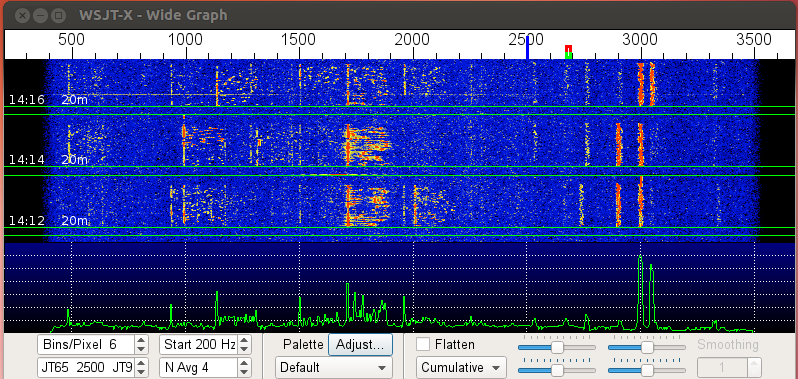

Figure 1: Typical WSJT-X waterfall with AGC turned off, Preamp off


Imagine you are halfway through a JT9 QSO, which takes about six minutes to complete, and a strong signal comes through for some other QSO or a CQ call; could even be at the opposite end of the passband.  Your transceiver’s AGC will reduce the RF gain and your weaker signal QSO may be artificially reduced beyond the JT decoder’s capability.  At this point, you may or may not be able to complete the QSO.  
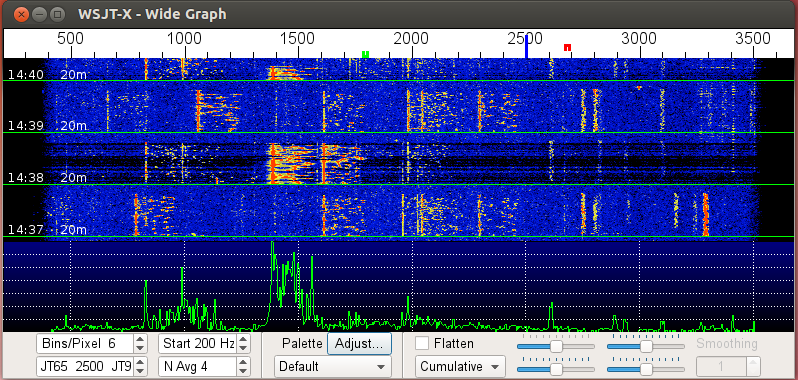

Figure 2: WSJT-X waterfall with AGC-F and Preamp off


From figure 2, the darker bands through time slot 14:38 is the effect of the AGC reducing the RF gain in the presence of the strong signal at about 1,375Hz.  To level set, blue is the typical WSJT-X waterfall colour displayed when there is enough audio drive from the rig, through the computer’s sound card, to the WSJT-X program.  Black indicates not enough audio drive.  From the above diagram, you can see that some of the weaker JT9 signals (> 2,500hz) are obliterated on the WSJT-X waterfall.  The JT modes are fairly robust, but a strong signal in the passband may be enough to disrupt a QSO when AGC is turned on.


In figure 3, I turned off the AGC prior to operation.  I received an answer to my CQ from a station in Spain.  I received this station’s hail at -27db below the noise floor.  The diagram shows a very faint trace at about 2,550Hz.  
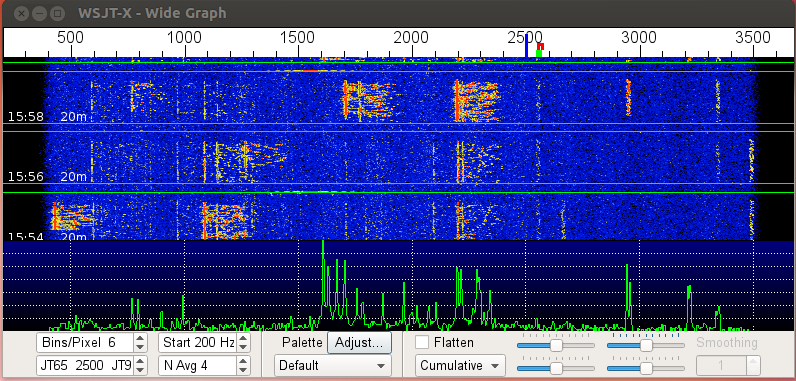

Figure 3: WSJT-X waterfall, active JT9 QSO with a Spanish station at -27db; preamp off
The presence of the strong signal at approximately 2,200hz in the passband may have caused the AGC to reduce RF Gain to a point where WSJT-X would not have been able to decode this very weak signal.  Fortunately, the AGC was turned off and other strong signals did not affect the RF Gain setting.

By switching off AGC, I have been able to successfully complete QSOs with very weak stations in the presence of stronger stations in the passband.  If not for the Elecraft reflector elmers, I would have likely continued operating digital with AGC turned on.

Thursday, 27 August 2015

Splashdown - Flight S4 Descends into the Norwegian Sea

The first report came in this morning at 0430Z (00:30 EDT) with a single station LA9JO reporting until 0654 when it was joined by SM0EPX/RX2. Only once did we see as many as four stations reporting, with the last one at 1130Z (07:30 EDT) heard by OH3HTI and again by SM0EPX.


The last altitude reported was 1,120 metres, down from 8000 metres. The Flight S-4 status page estimates it ditched at 1135Z after a steady descent of 920 metres per minute, just about the time I was on the repeater telling Geoff VA3GS how well it was doing.

Looking forward to the next flight.

Wednesday, 26 August 2015

Not Quite Norway: The Balloon Wanders Westward

We pick up the story in Finland this morning, with the balloon travelling North from Estonia to somewhat West and North of Helsinki through the night. We will never know the exact path it took, as the electronics power down when it gets too dark to drive the solar cells.

From southern Finland it crossed the Gulf of Bothnia heading Northwest into Sweden, picking up speed to a still-slow 28 knots, which gradually reduced through the day until its final report at 1818Z (14:18 North American Eastern Daylight Time) where it was doing just half that speed.


Its final reported position for the day is at the foothills of the Scandinavian Mountains, perhaps 150km from Norway (I do wish the map had a scale). It is not a densely populated area but the last report has it right over a road which winds it way around lakes and through the mountain valleys, continuing on to Norway. It looks like it might be a spectacular drive. The mountains are not particularly steep and the balloon is some 20,000 feet above their highest peak.

The WSPR reporting site shows LB9YE continuing to hear the WSPR transmissions for 48 minutes after the last position report. It only seems to have heard the "main" WSPR transmission, not the secondary information that provides temperature, battery condition and the final two digits of the grid square. Those reports show the balloon moving from JP85 to JP75, which includes both Sweden and Norway. LB9YE is on the Norwegian West coast about 185km Southwest of the last reported position.

Earlier in the day I checked the web site to see who was hearing the reports. First the first hour or so of the day there were reports from New Zealand and Australia.The site can also display a map of the communication paths between stations. This one shows all stations hearing VE3KCL at around Noon today.


In spite of being wrong 2 days in a row about its forecast direction, the winds appear to want to take it off the West coast of Norway only to make a right turn and head back towards Russia. As this may well happen overnight we may not see that track due to lack of overnight position reports. It might also head to Greenland if it picks up a different wind but we'll definitely know if it does that.

The Flight S-4 Status Page is also providing comments on the flight and is worth checking out. It has posted some other interesting links recently.

The development of new weak signal protocols has spawned great new opportunities for low coast experimentation with some spectacular results.

Tuesday, 25 August 2015

Balloon Experiment in the Doldrums

Once again the balloon's systems are asleep right now. The last transmission was heard by 22 stations, including one each in Australia and New Zealand. Not bad for 16mw.

Not much distance was made today due to very light winds aloft, with the final report of the day at only 4 knots. It has almost crossed the Baltic Sea from Sweden (after passing over Stockholm) to Estonia, making the island of Hiiumaa, part of Estonia and off its West coast, South of Finland.

The slow speed is evident from the meandering track shown on the map. The sharp right turn on the left hand side of the map is from the first report of the day. The overnight flight is always shown as a straight line from the last report of the previous day because the intermediate points are unknown, but it is likely that it held a track further West than the line indicates. The zig-zagging during the daytime trip, especially East of Stockholm as it slowed to a crawl, is due to the lack of precision in position reporting, which is done with 6 character Maidenhead Grid Locators.


The last reported temperature on board was -10.8C. During the day it is often around 30C, which is clearly inside the insulated electronics package the ambient temperature is about -40C. Before the electronics go to sleep the temperature starts dropping with the setting Sun, and the altitude usually drops a couple of hundred metres as well. We also see the battery voltage dropping, nearing the point where it is too weak to support the radio transmissions and other powered activities.

The winds are forecast to continue to blow from the West but will not pick up much, so when (if) it wakes up tomorrow morning it probably won't have even crossed Estonia.

Monday, 24 August 2015

Balloon crosses into Europe

The VE3KCL s-4 balloon experiment woke up this morning just off the coast of France spent the day working Northeast across the country, passing over Luxembourg, Germany, and reported its position just across the Danish border on its final transmission of the day. 14 stations, all in Europe, received this final report.

During the previous night, the winds aloft changed from Southeast to Northeast and then slowed down, and by the end of the day it was only doing 44 knots compared to 68 knots earlier in the day. It was closing in on Odense Denmark by nightfall, where sunset was 20:32 local, or 1832Z, just 10 minutes before that final report.

Based on the forecast upper level winds in Europe, it appears that the balloon will continue North and then veer towards the West, which if so will cause it to cross the West coast of Norway before heading towards Iceland and further North from there. Based on a smaller scale upper level wind forecast we might see the balloon pass Northward off the East coast of Greenland before doing a right hand 180 degree turn and heading North to South across Russia. Then again it could find its way along a more Eastward course over Denmark where the winds diverge a bit and go straight to those Southerly winds in Russia without taking another tour of the North Atlantic. We should know by tomorrow morning.

Of course, anything could happen between now and then. Before getting ahead of ourselves we can just hope that the balloon wakes up in the morning. If it really does find its way that far North it might stay in the midnight Sun for a while, giving us more reports from which to track its progress.

This map shows the track from a little before it shut down last night to the latest report. Note the little zigzag on yesterday's path from the West. It is an artefact of the position reporting which is limited to the precision of a Maidenhead grid locator.

The segment just before it reaches the coast of France is a straight line. This is another artefact due to the lack of reporting through last night. A straight line was drawn between consecutive points, but it is more likely that it really took a curved path somewhat South of that line.

So far the balloons have reported for 3 days and 5 hours and covered a distance of 7,668 km (as the crow flies, I believe). If you want to check out the position in the morning, a map is available.

Sunday, 23 August 2015

Update - Balloon Flight S-4

The intrepid pair of party balloons were more than 1/2 way over the North Atlantic by Sunday evening, when transmissions ended due to darkness. The last reported position is between the Azores and Iceland, west of Ireland. Darkness arrived early with transmissions ceasing at 2030Z (16:30 EDT), over 2 hours earlier than the night before where it was just off the coast of Labrador.

All seems OK so far. Altitude and speed was 60 knots. 15 stations on both sides of the Atlantic reported its final transmission for the day. You can check the WSPR web site for signal reports, click "Specify Query Parameters" and enter VE3KCL in the call sign box. The current track will mean that it will make landfall over Northern Spain, and it may well do that before the Sun rises and we see the next transmission. If it does, it will be the first in the series to cross the Atlantic Ocean.


It could be transmitting again as early as 3:30 EDT Monday morning, assuming all is well.

Saturday, 22 August 2015

Another Balloon Experiment Takes Flight

It crossed the region a little further North than the last one, crossing St. John's Sideroad about half way between Yonge and Bayview travelling eastward. Also unlike the previous flight, which crossed the South shore of Lake Ontario and was over Delaware when it reached the Atlantic Ocean, this flight (number 4) has stayed North of the 401, at least so far.

Check out the status page for this new mission. The last one made it more than 1/2 way over the Atlantic. Maybe this one will make landfall over Europe. The battery doesn't stay charged overnight so a little after dark the transmitter goes quiet and we wait until it gets light and hope we hear from it again.

Here's a full size map of the flight track.

Previous posts about flight #3: part one, part two.


Monday, 3 August 2015

Balloon Experiment Update

The balloon (see yesterday's post) hasn't been heard from since 6:44 pm last night (2244Z). As it would have been night time over the mid-Atlantic by then, it is probably due to the discharge of its batteries. By now (1514Z) it should have picked up again, so hopefully it is just due to unfavourable propagation and not a failure of some kind.

The day before, it shut down a little later (but of course was further West with more sun) but picked up operation quite early, as you can see from two successive beacon reports. Note the timestamps on the left in UTC, and that the last report of the evening was at 2320 reported by Germany and the first report in the morning was at 1052 reported in Illinois.

 2015-08-02 10:52  VE3KCL  10.140129  -21  -3  GM66  +13  0.020  K9AN  EN50wc  3576  2222 
 2015-08-01 23:20  VE3KCL  10.140152  -26  0  JB24  +23  0.200  DL8HAF/P  JO53dm  14354  8919

Digression: As mentioned before the WSPR protocol has been hijacked to provide additional information. The reports with the power shown (correctly) as 0.020 (20 milliwatts) are well-formed WSPR reports. The others (like the second line above) re-use the fields like the transmitter power to convey other information. 20 milliwatts was all that was needed to communicate 23,500 km to New Zealand, which is over 1,000 km per milliwatt, assuming the speculation that it was long path is correct (otherwise a mere 16,500 km).

The map appears to show it wandering around in the same area at the end of its path. The web site doesn't mention this and has no indication that anything might be amiss.


Hopefully all is well. I will watch, and wait.

Sunday, 2 August 2015

Balloon Experiment Crosses York Region

Toronto Ham David Beverstein, VE3KCL, Launched a balloon experiment consisting of 2 foil balloons filled with Hydrogen with a payload of WSPR, JT9 and CW telemetry beacons from a bit Southwest of the intersection of Airport Road and Highway 89. The track across our region runs more or less along King Road from King City to Gormley although the precision of the track is limited to that of a 6 character grid square due to bandwidth limitations in the WSPR protocol and a low duty cycle of 12 minutes per beacon to conserve power. At the time of writing it is over the North Atlantic about 1/2 way to Europe at about the latitude of Kentucky and has reached an altitude of almost 8000 metres.

This "mission" page gives more details on the project, the telemetry and the progress of the mission, or check out the full size map.

The main source of telemetry is the WSPR protocol. There are a large number of receiving stations for WSPR which makes it ideal (other than the low bandwidth) for very weak beacons. These receiving stations relay the information received to the WSPR Network web site where anyone can see them on the map. The site will automatically take you to the 30m reports which is the band used by this mission. If you don't see it try extending the time period to greater than 10 minutes. You may see the report come from a strange place, like I did when I saw it over the Southern tip of India. I think this is because of some of the additional telemetry (like battery condition and altitude) that is overlaid on the grid locator field in the WSPR protocol (there is a full description of how this works on the mission page, including the link to the raw WSPR decodes from the balloon's transmitter. If you go to the links in the previous paragraph the extended protocol is properly decoded and the map will show the correct position.

In the last 12 hours (at time of writing) it has been picked up by 10 stations in North America and 1 in New Zealand. A quick review of the raw telemetry data shows that 64 stations have picked up the balloon so far, including VA3ROM and VA3XCD in Thunder Bay and Yarker (about 30km NW of Kingston) Ontario respectively. A large number of reports have been made by VE1VDM, who has an advantage by being further East than most of North America.

The mission site reports that the JT9 transmissions have been received. However the PSKReporter network does not report any transmissions received at the time of writing. There are far fewer receiving stations on PSKreporter 30m JT9 than on WSPR and probably more importantly WSPR can operate on a lower signal to noise ratio.

Anyway if you're up for it set yourself up for WSPR and see if you can receive its transmissions while it's still in the air.

Chris VE3NRT

Saturday, 6 June 2015

WSJT-X V1.5 Released

Development of WSJT is very active right now. While 1.5 was in its final phases of testing (so-called "Release Candidates") the development team were hard at work on V1.6. The main feature of the new release is improved decoding, in terms of both the ability to decode weak signals and the speed it which decoding takes place. The decoding speed is greatly enhanced by the use of multiple processing threads (it looks like up to four). On my 3 year-old Pentium Core i7 computer the improvement is dramatic, normally with sub-second decoding times.

Release 1.6, which is under active development, is attempting to consolidate all the JT "slow" modes, like JT4, JT65A, B and C, and WSPR. WSPR is getting the most attention now and will include a scheduler for band hopping based on 4 time periods, which are day, night, and the twilight periods for gray line propagation. I think this will really increase usage of WSPR worldwide once it is released.

If you want a copy of WSJT-X V1.5, you can download it for free from the WSJT-X Web Site. If your station can run PSK31, then you can run WSJT-X, although you will need a way to synchronize your computer clock. Usually that's done with time servers on the Internet (more free software), although you can also use GPS or time signal stations.

Sunday, 26 January 2014

6 Metre Net - January 20th

For this week's net we had Charlie VE3SYK, Bob VE3WY, Brian VE3IBW and Chris VE3NRT. Everyone transmitting could hear everyone else this time. Steve, VE3EZ, also heard Chris but not the others (likely before Charlie checked in). Steve VA3SRV could see us on the SDR waterfall and reported by email that he could hear both the USB conversation and Nick on 50.140 FM. This may be an anomaly in Steve's SDR setup as we wouldn't expect to see an FM signal in that part of the band. It appeared to be a repeater input which makes the frequency even less likely. The strong FM is apparent in the image below, along with a much weaker and thinner looking upper sideband signal on 50.175.


Bob is 39km away from Chris which was the longest path of the night, and there are few obstructions between the two locations. Power at both ends was about 100W. Brian increased power from 10 to 50W which improved his signal, and Charlie complained of a higher noise due to a neighbour's activities. City dwellers would be ecstatic to have noise levels as low as Charlie's, mind you.

Frequencies on each radio varied somewhat although all were within about 200Hz, which is a mere 4 parts per million spread. Everyone reported having to tune above net controller Chris VE3NRT,

Paulo VE3RAO reported hearing voices buried in the noise from Richmond Hill, and Steve VE3EZ heard VE3NRT from Uxbridge. Like Steve, VA3SRV, neither had antennas that would allow them to transmit on 6m.


One topic of the night was to try out the FreeDV software for digital voice communications. As not everyone is going to have that set up we plan to test it on a different schedule sometime soon and perhaps put it in play a bit later. It would also be fun to try JT9 to see if the distances can be improved, and PSK, and RTTY, and perhaps some CW.

Six metres is a challenging band, which is why we're giving this net a try, to experiment and test 6m capabilities at our own stations. All amateurs are welcome to participate.