- Built-it-yourself precision GPS instrument (1cm accuracy). [Patrick VE3WST 2009-12-09]
- Shows what stations are spotted on the air.
- Lists all ham contests each week
- A spotting network for testing your signal (cw)
- A ham search engine
- Propagation prediction software.
- CWGET Program for learning Morse code
- CWTYPE Program for learning Morse code
- 45 minute documentary on laying transatlantic cables
- Video about ham radio and the lead up to the Internet. I've found a nasty link on this web site by the way, and have complained to the owner.
- Hints about putting wires in trees
- All things 160 metres
- Antennas on a chip. Just the ticket for the Internet of Things [Steve VA3SRV]
- Repeater Database [Geoff VA3GS]
- Good site for those interested in DXing [Geoff VA3GS]
- Yet another antenna site [Geoff VA3GS]
- QRP [Geoff VA3GS]
- Analogue & Digital Radio Information & Courses [Don VE3IXJ]
- IEEE Article on the exploration of Pluto [Don VE3IXJ]
Showing posts with label Propagation. Show all posts
Showing posts with label Propagation. Show all posts
Sunday, 20 March 2016
Compendium of old links
My hobby: Reading old editions of the Splatter... However, I started this post some time ago intending to republish old links that are still interesting and that still work but couldn't find a whole lot (not that I have a complete collection of Splatters). So instead I'm publishing a lot of more recent links sent out on the Yahoo reflector. Apologies to those I neglected to credit.

Saturday, 5 September 2015
Balloon Experiments in the Southern Hemisphere
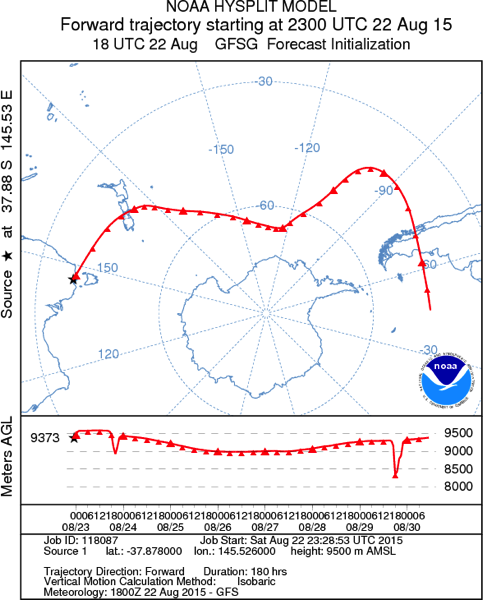
There's been a lot of coverage of the balloon launches of VE3KCL in this blog (see S-4 and S-3), an Australian Ham, Andy VK3YT has been using single (rather than double) party balloons and managed to have them circle the (southern part of the) globe several times in one flight.
He launched PS-50 on August 23rd and keeps a log of his exploits on the "Pico Space" web site. At the time of writing, the balloon has traversed about 170 degrees of longitude at around 40 degrees South latitude.
Like VE3KCL's payloads, Andy is using WSPR and JT9 protocols but uses the 20m band as well as 30m. It would be interesting to compare the methods and technologies of the two ventures.

He launched PS-50 on August 23rd and keeps a log of his exploits on the "Pico Space" web site. At the time of writing, the balloon has traversed about 170 degrees of longitude at around 40 degrees South latitude.
Like VE3KCL's payloads, Andy is using WSPR and JT9 protocols but uses the 20m band as well as 30m. It would be interesting to compare the methods and technologies of the two ventures.
Thursday, 23 July 2015
The Splatter now has a Propagation Forecast
... and it's not very good - at least not right now. Fair conditions day and night on 20 and 30m (where I'm running right now, so far working England and Texas), fair on 40/80 at night, and poor for everything else.
Anyway I thought I'd add it to the sidebar on the right immediately below the blogroll. I hope someone finds it useful. Let me know if you like it (or otherwise).
73,
Chris
P.S. It doesn't seem to show up in the mobile version of the site.
Anyway I thought I'd add it to the sidebar on the right immediately below the blogroll. I hope someone finds it useful. Let me know if you like it (or otherwise).
73,
Chris
P.S. It doesn't seem to show up in the mobile version of the site.
Subscribe to:
Posts (Atom)