Showing posts with label WSJT-X. Show all posts

Monday, 2 January 2017

AGC for Digital Ops: Friend or Foe?

Contributed by Brian Waterworth, VE3IBW.

I belong to the Elecraft reflector discussion group.  While I joined to learn more about my rig (KX3/PX3), I have found a wealth of amateur radio knowledge on various topics.  This group often has side conversations about everything Ham radio; sometimes Elecraft gear isn’t even mentioned.


One such tangent conversation centred around the use of AGC (Automatic Gain Control) for digital modes.  Being that I predominantly use digital for my HF operations, I was very interested in this topic.  The reflector elmers recommended turning off AGC when using digital modes.   


My research, prior to joining the Elecraft reflector, seemed to suggest that AGC should be on.  For digital modes, use the fast setting and for voice modes use the slow setting.  This seemed to work for me.  But I don’t think I really had a good grasp of what AGC was doing at that time.  A few years of operating PSK31, RTTY, and JT-modes revealed something that I unconsciously did not make a connection to AGC (fast or slow).  This reflector side conversation opened my eyes to AGC and its effect on my weak signal digital QSOs.


AGC, as many reading this article might know, is the ability of a transceiver to dynamically reduce RF gain when too much radio frequency energy is present in the passband.  The idea behind these adjustments is to avoid saturating downstream transceiver components (local oscillator, audio amp, your ear drums).  


I glibly referenced ear drums in the last paragraph because the reflector discussion turned to why AGC is nice to have when a strong signal enters the passband.  But, how many of us actually listen during digital operations?  I used to, but at a very low audio volume.  Beeps, twerps, blips, and clicks are a little fatiguing after a while.  For my current digital operations, I rarely have the speaker enabled and never listen through headphones.  All the information I need to operate digital is via a digital-mode program’s waterfall.


Narrow digital modes, such as PSK31 and JTx, enjoy many potential QSOs within a typical receiver passband.  A voice mode QSO, by contrast, occupies the entire passband.  During Field Day operations, PSK31 can have 20+ active QSOs in progress too.  If one of these QSOs happens to be a very strong signal, AGC will reduce the RF gain.  This doesn’t sound so bad.  However, in one passband (say 14.076MHz), you might have 20-30 active JTx QSOs and one of these might be yours with a weak station.


I use FLDigi to work PSK31 and RTTY during Field Day.  To compensate for strong signals in the passband, I created macros to reduce the receive filter bandwidth around a signal I was interested in trying to establish a QSO.  This worked great to filter out stronger adjacent signals in the passband.  But, was it necessary?  I am beginning to think it wasn’t.


Let’s look at an example using WSJT-X.  It doesn’t have the convenience of macros to adjust and re-instate filter settings like FLDigi does.  


I got interested in JT modes over the past two years as I wanted to work QRP and be able to make contacts around the world with very little power (5 watts or less).  I also wanted to do this in a portable fashion (on a sailboat, in a park, on an island, in my backyard on a nice day).  JTx modes seemed like the best candidate.  There are some JT-mode operators that use 30+ watts.  There are also band conditions that will present a low power signal as 0db or more above the noise floor; i.e. a strong JTx signal.  With AGC enabled, these stronger signals will reduce the RF gain.  Weak signals will become weaker.


Each trace, (JT65 between 0-2,500hz and JT9 above 2,500hz) in figure 1, is a CQ or an active QSO within one passband.  The darker red and deeper yellow colours represent stronger signals.  You can see there are some very weak signals where there is no red at all (usually between -15db and -25db below the noise floor).
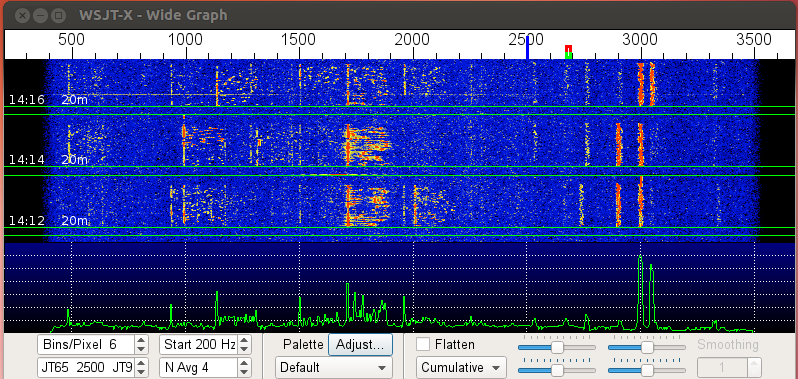

Figure 1: Typical WSJT-X waterfall with AGC turned off, Preamp off


Imagine you are halfway through a JT9 QSO, which takes about six minutes to complete, and a strong signal comes through for some other QSO or a CQ call; could even be at the opposite end of the passband.  Your transceiver’s AGC will reduce the RF gain and your weaker signal QSO may be artificially reduced beyond the JT decoder’s capability.  At this point, you may or may not be able to complete the QSO.  
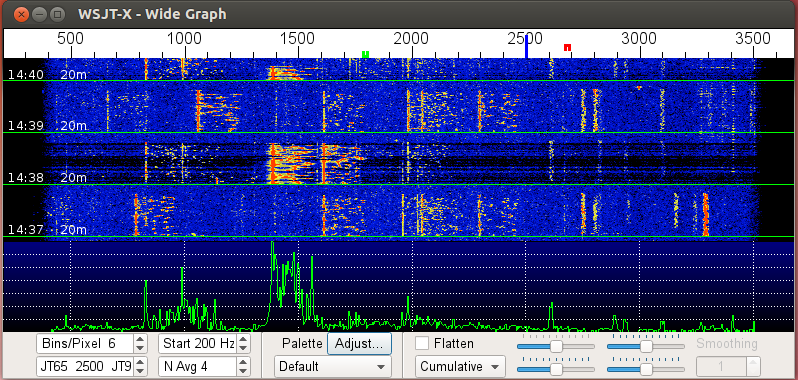

Figure 2: WSJT-X waterfall with AGC-F and Preamp off


From figure 2, the darker bands through time slot 14:38 is the effect of the AGC reducing the RF gain in the presence of the strong signal at about 1,375Hz.  To level set, blue is the typical WSJT-X waterfall colour displayed when there is enough audio drive from the rig, through the computer’s sound card, to the WSJT-X program.  Black indicates not enough audio drive.  From the above diagram, you can see that some of the weaker JT9 signals (> 2,500hz) are obliterated on the WSJT-X waterfall.  The JT modes are fairly robust, but a strong signal in the passband may be enough to disrupt a QSO when AGC is turned on.


In figure 3, I turned off the AGC prior to operation.  I received an answer to my CQ from a station in Spain.  I received this station’s hail at -27db below the noise floor.  The diagram shows a very faint trace at about 2,550Hz.  
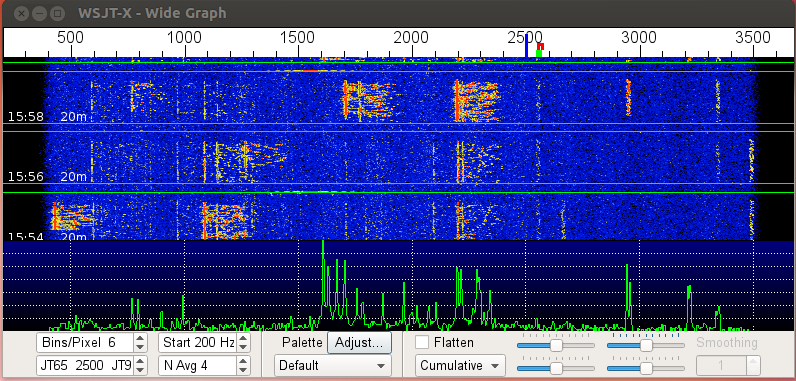

Figure 3: WSJT-X waterfall, active JT9 QSO with a Spanish station at -27db; preamp off
The presence of the strong signal at approximately 2,200hz in the passband may have caused the AGC to reduce RF Gain to a point where WSJT-X would not have been able to decode this very weak signal.  Fortunately, the AGC was turned off and other strong signals did not affect the RF Gain setting.

By switching off AGC, I have been able to successfully complete QSOs with very weak stations in the presence of stronger stations in the passband.  If not for the Elecraft reflector elmers, I would have likely continued operating digital with AGC turned on.

Thursday, 17 September 2015

First Impressions of Windows 10

So I've had a laptop running Windows 10 for some time. It's not my work laptop, which is on Windows 7 until our corporate IT group deems otherwise, but one which I sometimes use for ham radio. It has plenty of memory (8GB) and a solid state disk drive (256GB). The only problem I've seen so far is that sometimes the mouse pointer stalls - pretty annoying at times but I can't necessarily blame Windows 10 for it and haven't looked into it because I don't use that computer very much. I was pleased to see that one old device I have for which the latest driver was written for Vista still worked under Windows 10-64.


So I took the plunge and migrated the big desktop as well. This system is a Dell XPS 9100 with two 23" monitors is integrated into the station and a bunch of other technology and so has the greatest chance of having a problem. The key thing, of course, is how well all the devices and applications work. So far it's mostly good. Here's a list I've made up in my first 3 days of operation.

Devices

  1. Rig Control through an inexpensive 4-port PCI Express serial interface - no issues.
  2. KAT500 control through the Elecraft USB to Serial adapter - no issues.
  3. Echo Audiofire 12, a 12 channel 96 KHz audio interface connected to the system's built in Fire-wire port. No issues.
  4. Mouse and Keyboard - no issues
  5. Intel Rapid Storage Technology - This software manages the mirroring of my system drives. It worked as before and reported that the drives were healthy.
  6. A Logitech USB headset which I hadn't used for some time (before I had to rebuild my Windows 7 system due to a head crash, ergo the mirrored drives I run now). The driver installed automatically.

Operating System

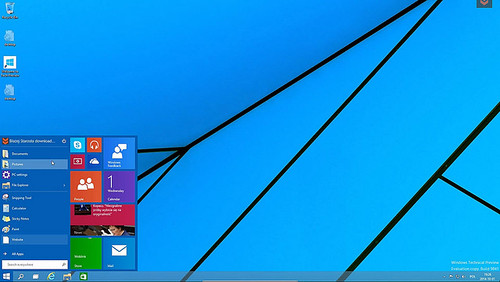
  1. I was concerned at first because I saw the task bar icons on the secondary monitor, so at first glance it looked like it was replicated the primary monitor extend of extending the desktop. This turned out to be a feature, so that those icons are available on either monitor. That`s a good idea I think because it makes switching between applications easier.
  2. Windows Edge took over as my default browser from Chrome. I launched Chrome manually and it came right out with a video on how to make Chrome my default browser and pin it to the task bar. Ain't competition great!

Radio Applications

  1. JT-Alert and WSJT-X worked just fine. The first time I tried to transmit the tones came out the wrong sound card, but it was easily set to rights in the WSJT-X options menu and I was back in business on the next go-round.
  2. Elecraft Utilities - work as before (KAT500, KPA500, etc)
  3. DXLab - Launcher worked as did all the applications I tried including DXKeeper, Spot Collector (using Telnet and IRC), ...
  4. FreeDV. The WAE SSB contest was under way so no joy on getting a QSO 20m but the application seems to work just as well as it did on Windows 7. I managed to crash it once but getting ahead of it but I can't blame Windows 10 for that. It's minimal rig control (PTT only) worked fine too.
  5. FLDIGI with the FLDIGI DXLab Gateway also worked perfectly for several PSK31 and PSK63 QSOs.

Other Applications

  1. Courtesy of the my office I have the Adobe Creative Cloud on my home desktop computer and use Adobe Lightroom to edit and catalogue photos for this blog. Under Windows 10, Adobe Lightroom has a problem with the AMD Radeon graphics driver. The consensus is that it is a driver bug and the solution is either to regress to the previous version of the driver or to disable graphics acceleration in the application. I chose the latter and it works fine, although I'll have to remember to change it back if and when the bug is fixed by AMD.
  2. Microsoft Office 365 also worked fine. I'd have been quite surprised if it hadn't.
So far, after 4 days of operating, it's working well. No big problems. Your mileage may vary though.

Thursday, 9 July 2015

WSJT-X - Filling in the missing pieces

WSJT-X works as a standalone program and I used it that way for some time. Recently, as I mentioned in my last post, I enabled the connection to pskreporter so I could see whether similarly set up stations received my signal. Later versions of WSJT-X will even show your signal strength of the other station, which is an excellent way to determine band conditions, although sometimes it is frustrating when a station you want to work hears you but doesn't answer. However, as the system will run just fine unattended they may be just out of the shack rather than intentionally ignoring you.

WSJT-X keeps its own log in ADIF and text format which is fine for uploading, although you'd need to ensure that you're only uploading or importing the contacts logged since the previous upload. Also it records minimal information so if you want to record the US state for instance it lacks that capability, so I've typically entered JT65 contacts by hand into my logging program (DXLab/DXKeeper in my case) and suffered the consequences of various typos.

I'd heard about a program called JT-Alert but never found the time to try it until Canada Day, when I was cleaning up the shack and doing some research. The program was written by VK3AMA and is a free download for various versions of Windows. The advantage of JT-Alert is that it works with various logging programs to determine whether the call signs picked up by WSJT-X have been worked before on the same band and mode (WSJT-X will only tell you if you've worked the station before on any band or JT mode) and whether it's a new zone, country, state or grid (selectable by band so I only have grids set up on VHF, for instance). It even has a voice alert that will announce things like "New Grid" in your choice of male or female British voices, assuming you have a separate sound card from the one you use to connect to your radio.

The program supports standard ADIF files, DXLAB DXKeeper, HRD V5 or V6, Log4OM and MixW (CSV File), meaning it will work for just about everyone. It will also work with JT65-HF, which is an alternative implementation of the JT65 protocol with slightly different features.

So now the suite of software I run for JT65 and JT9 are as follows:
  • WSJT-X V1.5
  • JTAlertX 2.6.3
  • DXLab DXKeeper 13.0.6
  • Meinberg NTP (Network time protocol which is essential to keep your system clock in synch)
  • PSKreporter (although this is a service, not a program you download)
  • TrustedQSL which DXKeeper uses to upload and synchronize logs with ARRL Logbook of the World (LoTW)
After a week or so of operating I've discovered the following:
  • JT-Alert (at least with the settings I have currently) will advise me of new continents, zones, countries, grids (on 6m, as I've set it that way) and states for any station I've not worked before on that band and mode - whether they're calling CQ or not. In the 10 seconds available to decide what to to after seeing all the decodes come through, there's still some excitement in picking the best station to respond to that's actually calling CQ. The ideal way to do this is to look use the "decodes history" window but unfortunately you need to look at the right hand column to see whose calling CQ, then the left column to choose the best option to respond to, then find that station in the WSJT-X decode display, and then double click on it.
  • The programs should be started in a particular order. Meinberg NTP starts automatically on system startup, which is good because it can take 20 minutes or so to synchronize the system clock with network time. Then DXKeeper should be started. This is most important because otherwise JT-Alert will start it in the background. It will successfully look up stations that are heard in the DXKeeper log, but fail to actually log completed contacts. You will not be able to bring up the DXKeeper user interface either, as it will tell you that it's already running. Then JT-Alert can be started and it will prompt you to start WSJT-X.
  • There are several versions of JT-Alert that will be installed. You need to use the one that matches the JT65 program you are using. JT-Alert X is the one for WSJT-X.
  • It would be nice if I could somehow tell whether a "new country" was (a) never worked on any band (b) never worked on the band that I'm currently on (c) never worked on the mode (JT9 vs. JT65) that I'm currently using, or (d) whether it's just the band/mode combination that is new. I would give higher priority to stations earlier on the list.
  • In the end though, I will work anyone anywhere if I haven't worked them on that band/mode combination before. It's just that new countries, grids and states will be worked first.
  • In a week I haven't worked a single new country, although I've heard a couple (India and Indonesia) and worked some new band/country combinations on 30m and 17m.

JT-Alert is a way better method than what I was doing before, which was scrambling to look up stations I'd seen on the WSJT Band Activity window to see if I'd worked them on that band. This way is much more relaxing, but still has an element of decision making. I imagine someone, somewhere, is working on an add-on to run a fully automated station. That would be an interesting challenge to correctly respond to some of the non-standard messages that you see in this mode, and also to limit QRM with other stations on the band. Such a program would also ideally manipulate the power level of the transmitter to match the station being called. If see a station below -15db, for instance, I'll usually up the power, and if they're showing -5db or more, I'll usually lower it. Then I'll further adjust power based on the signal report I receive, sometimes taking observations of fading into account. If I answer a station calling CQ who then calls CQ again, I'll also up the power. Sometimes they don't hear me because I'm not the only station calling, but other times it's because they don't hear me as well as I hear them.

Monday, 22 June 2015

Summer Starts with a Bang on 6m

On June 21st, the first full day of Summer in the Northern Hemisphere, 6m was in fine form. After noticing various CW and SSB signals on the 'scope, I managed to work a couple of US stations but found that most signals I was seeing were answering other stations rather than calling. To see how conditions were, I fired up WSJT-X and connected to the pskreporter web site.

This combination can show who hears your station, whether they answer or not. I only starting using it this year and have seen nothing like it before. Most of the time I see half a dozen stations that can hear me - often less. When there's no enhanced propagation it's usually the same 3 stations, VE3NLS, VE3CGR and K2MJ across the lake. Many openings go to the South East US stations but it is rare to see the Western US. The picture I saw when I opened pskreporter this time was extraordinary. I wish I could have worked them all.


Each of the little balloon tags represents a station that heard me. You can see a huge swath in the South East US but also the North East, Mid West and South West all well-represented.

By the end of the day I'd logged a couple of new countries (Venezuela and the Dominican Republic) and a dozen new grid squares. Pretty good for a little delta loop antenna that is lower than the roof of the house.

It's also interesting that stations 100km away are almost always workable on 6m. This is well beyond line of sight and more than likely is a result of tropospheric scatter, too weak for SSB communications but easily done with JT65.

What an amazing day for 6m!

Saturday, 6 June 2015

WSJT-X V1.5 Released

Development of WSJT is very active right now. While 1.5 was in its final phases of testing (so-called "Release Candidates") the development team were hard at work on V1.6. The main feature of the new release is improved decoding, in terms of both the ability to decode weak signals and the speed it which decoding takes place. The decoding speed is greatly enhanced by the use of multiple processing threads (it looks like up to four). On my 3 year-old Pentium Core i7 computer the improvement is dramatic, normally with sub-second decoding times.

Release 1.6, which is under active development, is attempting to consolidate all the JT "slow" modes, like JT4, JT65A, B and C, and WSPR. WSPR is getting the most attention now and will include a scheduler for band hopping based on 4 time periods, which are day, night, and the twilight periods for gray line propagation. I think this will really increase usage of WSPR worldwide once it is released.

If you want a copy of WSJT-X V1.5, you can download it for free from the WSJT-X Web Site. If your station can run PSK31, then you can run WSJT-X, although you will need a way to synchronize your computer clock. Usually that's done with time servers on the Internet (more free software), although you can also use GPS or time signal stations.