"Reprinted" from a past issue of Splatter.
By Greg VA3VFO
Good to hear about the Project Nights and interest in soldering skills.
My tips for those starting out are often over-looked or underestimated by even experienced folk, but should especially help our new project builders.
One of the first lessons taught is the requirement of “tinning” the new tip of your iron or gun, (much like “seasoning” a new cast-iron fry pan).It is equally important to continue to make sure the tip remains tinned as it ages and wears down. When neglected, it leads to much frustration, and the beginner may not realize this is the cause of so much grief.
If the joint is not quickly “wicking-up” the wet solder, or if you find you have to really heat up the joint ONLY, chances are you have an oxidized tip that is not holding its “tinning”.
It is very important to apply the solder to not only the joint of the connection, but at the intersection of the joint AND where the tip makes contact with the joint. A dark or blackened tip that seems to repel the solder should be repaired or replaced. For the tip to transfer heat properly, it MUST be “silver/light grey” in colour and accept solder over its total tip contact area. Simply wiping the tip on a cloth or damp sponge won’t work! You have to remove the build up of oxidization and this can be tricky on some types of tips.
Tips usually come with factory plating on the tip. I am not sure of the various plating materials used, but would guess silver or similar alloy. Some tips you have may be copper only. You may tempt to sand, grind or file down the tip to renew its surface. This can destroy or remove the coating of its plating material, which is so important to its ability to hold the “tinning” and to transfer heat. Yes, you may find it necessary to grid down a tip- go for it. Make a specialized tip to solder that micro-small surface mount part, or to squeeze into a tight space, but beware! If you do this, accept that the tip will lose its proper plating finish and will be subject to FAST re-oxidation. So keeping it fresh becomes an ongoing concern.
You will have to watch for poor heat transfer caused by “cold spots” on the tip. These are areas, which stubbornly repel solder- usually from solder flux residue or spots of oxidization. The longer a tinned copper tip sits plugged in, the more it will oxidize! After a good tinning, unplug, let cool and store away. Don’t store a plated or copper tip without a good fresh coat of solder. You may ruin a good tip trying to restore it to take full tinning. When possible, always buy the properly plated tip for your work! Only file or grind a “custom” or old tip if you have to.
Since an oxidized tip will not transfer heat well, it will take longer to heat the material. You likely know that too much heat can render some electronic parts (transistors etc) useless. But often, not enough heat is just as bad. I would much rather apply a high heat to a part for a quick, shorter period of time, than having the part and its support connections, like plastic insulators or the centre core of coax, melt away or become deformed. So “turn UP” the heat by simply keeping a well tinned tip at all times. If you are still having problems with nice wet joints, you may want to use a higher-powered iron (or gun for the heavy stuff, like coax connectors).
One last trick for stubborn tips that just won’t tin properly is to dip them into acid solder flux (used for plumbing, NEVER for electronics). Re-tin them IMMEDIATELY. You can try this if a very light sanding or steel wool pad fails to clean a plated tip. Plated tips can be gently “refinished” but careful not to “peel-way” the factory applied plating. An old tip can be sacrificed or filed into a fine point, but extra special attention to maintaining a “good tin” is paramount once the copper under the platting is exposed. It is just as likely to have a new plated tip “go cold” and not accept solder, so watch for that problem at all times!
Keep the oxidization off your tip. Keep it shiny and hot and you will have mastered the biggest secret of becoming a master solderer…er!
Greg
VA3VFO
Monday, 7 September 2015

Sunday, 6 September 2015
Junk in the Trunk 2015
This year's Junk in the Trunk seemed to have more selection than usual. Maybe it was just that I didn't wait until it was almost over to show up this time. Geoff VA3GS knew I was looking for a way to put a wire antenna in the trees and noticed a tennis ball slingshot with an attached fishing reel that I tried out almost as soon as I got it home and had a successful launch on the first attempt.
It was good to get see some of the club members who we haven't seen since Field Day or the AGM. Here's a quick video of the merchandise.
The smooth fast motion was, as you might have guessed if you watched all the way to the end, courtesy of Microsoft Hyperlapse, which is available as a no-cost trial until October 1, 2015. Click on the picture below to see some more photos of the event.
It was a beautiful day to get together, find some of those items we were looking for, and to talk about ham radio.
Saturday, 5 September 2015
Balloon Experiments in the Southern Hemisphere
There's been a lot of coverage of the balloon launches of VE3KCL in this blog (see S-4 and S-3), an Australian Ham, Andy VK3YT has been using single (rather than double) party balloons and managed to have them circle the (southern part of the) globe several times in one flight.
He launched PS-50 on August 23rd and keeps a log of his exploits on the "Pico Space" web site. At the time of writing, the balloon has traversed about 170 degrees of longitude at around 40 degrees South latitude.
Like VE3KCL's payloads, Andy is using WSPR and JT9 protocols but uses the 20m band as well as 30m. It would be interesting to compare the methods and technologies of the two ventures.
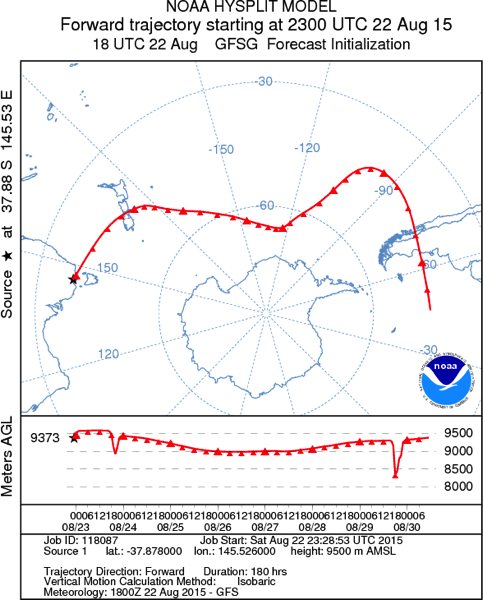
He launched PS-50 on August 23rd and keeps a log of his exploits on the "Pico Space" web site. At the time of writing, the balloon has traversed about 170 degrees of longitude at around 40 degrees South latitude.
Like VE3KCL's payloads, Andy is using WSPR and JT9 protocols but uses the 20m band as well as 30m. It would be interesting to compare the methods and technologies of the two ventures.
Friday, 4 September 2015
On My Way to Mars
A recent ARRL letter provided a link to a NASA web site that takes your name (and call sign) and includes it on a microchip in on the "Insight" mission Mars lander. There's no explicit way to add the call sign so I added it after my last name. Last day to register is September 8th. All aboard!
 |
| Boarding Pass |
Thursday, 3 September 2015
Volunteer at the Hamfest - Top 10 Reasons
From the September 2005 Splatter
- Be part of the team of the #1 Hamfest in Ontario
- Get into the Hamfest for free
- It's a fun day for a few hours work
- A chance to meet fellow Hams
- Opportunity to pick up the odd Christmas present
- A chance to participate in another aspect of the hobby
- Variety of volunteer "activities" to choose from
- Be involved in the "behind-the-scenes" aspects of a Hamfest
- Jan (ed: now Geoff) will stop petering you to sign up
- It's the Club's (your Club's) primary source of money. The success of the Hamfest ensures a sound financial basis for the Club.
I'll add to this that for high school students it may also count for community service hours. Contact Geoff for more information.
Wednesday, 2 September 2015
Astrophysics: Exploring Exoplanets
Professor Paul Delaney of York University has long (as in more than 10 years) been one of, if not our most, popular presenters at club meetings. His presentations always pay particular attention to the fascinating topic of exoplanets, where new discoveries are being made daily. Professor Delaney will be presenting at our October 6th meeting.
For those that want to know more and are willing to invest several hours a week to develop a deeper understanding of the topic, the Australian National University in Canberra is offering the course "Astrophysics: Exploring Exoplanets" through its association with edX, which is organizes access to courses of dozens of Universities, including MIT and Harvard which govern its operation.
The course itself is free, although if you want the certificate it is $50 US. It is wise not to underestimate the effort required to complete the course, though. It will take several hours of study each week. The course starts on September 15th, and follows a schedule rather than being self-paced. Course assistants are available on-line to answer questions.
In general, the courses offered by edX are very well received. Bob VA3IL recently took "Introduction to Computer Science and Programming Using Python" (i.e. the Python programming language) and thought highly of it, although he found the assignments to be quite a bit of work (this course is probably at the high end of the workload spectrum, mind you). If you're interested in this course it started on August 26th so you likely have time to catch up.
Some other courses that were recently announced:
Signing up is simple, and I'm sure Prof. Delaney would be delighted to see some club members showing a higher level interest in the topic.
For those that want to know more and are willing to invest several hours a week to develop a deeper understanding of the topic, the Australian National University in Canberra is offering the course "Astrophysics: Exploring Exoplanets" through its association with edX, which is organizes access to courses of dozens of Universities, including MIT and Harvard which govern its operation.
The course itself is free, although if you want the certificate it is $50 US. It is wise not to underestimate the effort required to complete the course, though. It will take several hours of study each week. The course starts on September 15th, and follows a schedule rather than being self-paced. Course assistants are available on-line to answer questions.
In general, the courses offered by edX are very well received. Bob VA3IL recently took "Introduction to Computer Science and Programming Using Python" (i.e. the Python programming language) and thought highly of it, although he found the assignments to be quite a bit of work (this course is probably at the high end of the workload spectrum, mind you). If you're interested in this course it started on August 26th so you likely have time to catch up.
Some other courses that were recently announced:
- Transforming Business, Society, and Self with U.Lab: Join the global movement to build a new economy by co-sensing and co-creating the emerging future (MIT)
- Solar Energy: Discover the power of solar energy and learn how to design a complete photovoltaic system (Australian National University)
- Discovery Precalculus: A Creative and Connected Approach: This is an inquiry-based exploration of the main topics of Precalculus. The emphasis is on development of critical thinking skills (University of Texas at Austin)
- The Ancient Greek Hero in 24 Hours: Discover the literature and heroes of ancient Greece through the Homeric Iliad and Odyssey, the tragedies of Sophocles, the dialogues of Plato, and more (Harvard)
- M&A Professional Certificate Part 1 – Concepts and Theories: An Introduction. If your goal is a career on a broker-dealer’s M&A desk (New York Institute of Finance)
- Principles of Electric Circuits: Learn sufficient techniques for analyzing and designing circuits (Tsinghua University)
- Introduction to jQuery: Learn how to use jQuery to simplify common tasks in JavaScript to quickly add interactivity to web pages (Microsoft)
- Music Production and Vocal Recording Technology: Explore emerging innovations in vocal production, audio engineering, recording, and mixing (Berklee College of Music)
- Science at the Polls: Biology for Voters, Part 1: Each year, as voters you are asked to make decisions on ballot initiatives on matters of biology, medicine, agriculture and the environment. Enroll in this course to learn how biology and your vote are connected (University of California: Berkeley)
- Terrorism and Counterterrorism: What is the danger of terrorism, and how can the world respond effectively? (Georgetown University)
- Electronic Interfaces: Bridging the Physical and Digital Worlds: Learn by doing: analyze, design, and build electronic interfaces between sensors and a microcontroller to build a robot or your own creation in this hands-on lab course (University of California: Berkeley)
So many courses - so little time...
Signing up is simple, and I'm sure Prof. Delaney would be delighted to see some club members showing a higher level interest in the topic.
Tuesday, 1 September 2015
YRARC - Meeting Tonight
The first meeting of the 2015-2016 is tonight - Tuesday, September 1st, 2015 after an all-too-short summer. Tonight's meeting will feature a presentation by Dave Rajnauth, VE3OOI on the topic of model rocketry and amateur radio which I'm sure will be of interest to most of our members.
The meeting is at the usual time and place - 7:30pm at the Sharon Temperance Hall, adjacent to the parking lot for the Sharon Temple.
We will be approving both the minutes of the June 2nd General meeting, and the June 2nd Annual General Meeting tonight. Please take a moment to read them.
The meeting is at the usual time and place - 7:30pm at the Sharon Temperance Hall, adjacent to the parking lot for the Sharon Temple.
We will be approving both the minutes of the June 2nd General meeting, and the June 2nd Annual General Meeting tonight. Please take a moment to read them.
Subscribe to:
Posts (Atom)